1. Introduction: Why Most AI Content Sounds Robotic
❓Have You Ever Read AI Content That Felt Robotic?
You open a blog, start reading, and after a few paragraphs something feels strange. The grammar is correct, and the information looks fine, but the writing feels flat. Every sentence sounds similar. There is no personality, no emotion, and no real connection with the reader. Instead of learning from a person, it feels like you’re reading words put together by a machine.
If you’ve ever felt this way, you’re not alone.
Today, millions of people use AI tools like ChatGPT, Gemini, and Claude to create content faster. These tools can save a lot of time and help you overcome writer’s block. But there is one big challenge—AI can only give you a starting point. If you publish its first answer without improving it, your content may sound robotic and forgettable.
The good news is that creating natural, human-like AI content is a skill anyone can learn. You don’t need years of writing experience. You simply need to know how to guide AI, edit its answers, and add your own ideas. That’s what turns an average AI draft into content that people enjoy reading and trust.
In this guide, you’ll learn a simple step-by-step system to create high-quality AI content that sounds natural. We’ll cover better prompting, smart editing, fact-checking, adding personality, and avoiding common mistakes. By the end, you’ll have a practical workflow you can use every time you create content with AI.
💡 FTPLAYEZ™ Quick Preview
By the end of this guide, you won’t just know how AI writes—you’ll know how to make AI write like a helpful assistant while your own knowledge, creativity, and experience make the content truly valuable.
🔄 Smooth Transition
Now that you know why many AI articles sound robotic, let’s answer the most important question: What actually makes AI content sound human? Understanding this is the foundation of creating content that people enjoy reading and trust.
📑 Table of Contents
1. Introduction: Why Most AI Content Sounds Robotic
2. What Makes AI Content Sound Human?
3. The FTPLAYEZ™ H.U.M.A.N. Framework
4. Write Better Prompts to Get Better AI Output
5. How to Edit AI Content Like a Professional
6. Add Human Personality & Originality
7. Fact-Checking & Building Trust
8. Common Mistakes That Make AI Content Feel Robotic
9. Human Content vs AI-Only Content
10. Practical Workflow: From Prompt to Published Article
11. Real-World Examples Across Different Professions
12. Frequently Asked Questions
13. Final Thoughts & Next Steps
2. What Makes AI Content Sound Human?
❓What Does “Human-Like” AI Content Really Mean?
Many beginners think that “human-like” content means adding a few emotions or changing some words. That’s only a small part of it.
Human-like content is writing that feels natural, clear, and helpful. It answers the reader’s question in a simple way. It sounds like a real person sharing knowledge—not like a machine repeating information.
Think about talking to a friend. You don’t use the same sentence again and again. You explain ideas step by step, give examples, and try to make the other person understand. Good content works the same way.
🌍 Real Example
Imagine you ask AI:
“What is SEO?”
A basic AI answer might say:
“SEO is the process of optimizing websites to improve visibility in search engine results.”
The information is correct, but many beginners may not understand it.
A more human version could say:
“SEO helps your website appear higher on Google when people search for topics related to your content. For example, if someone searches ‘AI content writing tips’ and your blog appears near the top, that’s the result of good SEO.”
The second answer is easier to understand because it explains the idea and gives a real example.
💡 What Makes Content Feel Human?
High-quality AI content usually includes:
• Clear and simple language.
• A logical flow from one idea to the next.
• Practical examples.
• Helpful advice readers can use.
• A natural writing tone.
• Original thoughts or personal insights.
These small improvements make a big difference. Readers stay engaged because the content feels like it was written to help them, not just to fill a page.
💡 Actionable Tip
After AI writes your first draft, read it out loud. If a sentence sounds awkward or doesn’t feel like something you would naturally say, rewrite it. Small edits often make the biggest difference.
📌 Key Takeaway
Human-like AI content isn’t about hiding the fact that you used AI. It’s about making sure every sentence is clear, useful, and written for real people. AI can create the first draft, but your editing, examples, and judgment are what make the final content valuable.
🔄 Smooth Transition
Now that you know what makes AI content feel natural, the next step is learning a simple system you can follow every time. In the next section, we’ll explore the FTPLAYEZ™ H.U.M.A.N. Framework—a practical method for creating AI content that readers enjoy and trust.
3. The FTPLAYEZ™ H.U.M.A.N. Framework
❓Is There a Simple System for Creating Human-Like AI Content?
Many beginners believe that creating great AI content is about finding the “perfect prompt.” While prompts are important, they are only one part of the process. High-quality content comes from following a clear system from start to finish.
That’s why I created the FTPLAYEZ™ H.U.M.A.N. Framework. It gives beginners an easy method to create content that is useful, natural, and trustworthy.
Let’s break it down step by step.
H — Have a Clear Goal
Before opening any AI tool, ask yourself one question:
“What do I want this content to help the reader achieve?”
A clear goal helps AI produce more focused answers.
🌍 Real Example
Instead of asking:
“Write a blog about AI.”
Try asking:
“Write a beginner-friendly guide that teaches students how to create AI content that sounds natural.”
The second prompt gives AI a clear direction.
U — Understand Your Audience
Good content is written for people, not for AI.
Think about who will read your content. Are they beginners, business owners, students, or marketers? Understanding your audience helps you choose the right words, examples, and explanations.
🌍 Real Example
A beginner needs simple language and basic examples. An experienced marketer may prefer advanced strategies and technical details.
M — Make It Personal
AI can explain ideas, but it cannot replace your own experience and perspective.
Add your own examples, lessons, or observations whenever possible. This makes your content more original and helps readers trust your advice.
🌍 Real Example
While building FTPLAYEZ, I learned that AI can create a fast first draft, but the real improvement happens during editing. Adding practical examples and clearer explanations always made the final article much more useful for beginners.
A — Assess and Improve
Never assume the first draft is perfect.
Read the content carefully. Improve weak sentences, remove repeated ideas, and check that every paragraph answers the reader’s question.
Small edits can make a big difference.
N — Never Publish the First Draft
This is the most important step.
Before publishing, check your facts, improve the flow, and make sure the content sounds like a real person. A few extra minutes of editing can turn an average article into a valuable one.
💡 Actionable Tip
Before you publish, ask yourself:
“Would I enjoy reading this if someone else wrote it?”
If the answer is no, keep improving it.
📌 Key Takeaway
The FTPLAYEZ™ H.U.M.A.N. Framework is more than a writing method. It’s a simple habit that helps you create AI-assisted content people can understand, trust, and enjoy. Instead of depending on AI alone, you learn how to combine AI’s speed with your own thinking and creativity.
🔄 Smooth Transition
Now that you have a complete writing system, the next step is learning how to give AI better instructions. In the next section, you’ll discover how better prompts lead to better content—and why small changes in your prompt can completely change the quality of AI’s response.
4. Write Better Prompts to Get Better AI Output
❓Why Do Some People Get Better AI Results Than Others?
Have you ever asked AI the same question as someone else but received a much worse answer?
Many beginners think the problem is the AI tool. In most cases, the real problem is the prompt.
A prompt is simply the instruction you give to AI. The quality of your instruction has a direct impact on the quality of the response. Think of AI like a skilled assistant. If you give clear instructions, you’ll usually get a better result. If your instructions are vague, the answer will often be vague too.
This is why learning to write good prompts is one of the most valuable skills in AI content creation.
🌍 Real Example
Imagine you want AI to write a blog introduction.
A weak prompt might be:
“Write an introduction about AI content.”
AI doesn’t know who the audience is, what tone to use, or what the goal of the article is.
Now compare it with this prompt:
“Write a beginner-friendly introduction for a blog called ‘How to Create High-Quality AI Content That Sounds Human.’ Use simple English, keep the tone friendly, explain why many AI articles sound robotic, and encourage readers to continue reading.”
The second prompt gives AI a clear direction, so the result is usually much better.
While creating FTPLAYEZ guides, I learned that AI doesn’t need perfect prompts—it needs clear instructions. Whenever I explained the audience, goal, and writing style, the answers became much easier to improve. A clear prompt didn’t remove the need for editing, but it saved a lot of time and gave me a much stronger starting point.
📊 Weak Prompt vs Strong Prompt
| Weak Prompt | Strong Prompt |
| “Write about AI.” | “Write a beginner-friendly blog about AI content creation using simple English, practical examples, and actionable tips.” |
| Gives little context | Clearly explains the goal and audience |
| Produces general answers | Produces focused and relevant answers |
| Needs more editing | Usually needs fewer improvements |
| Saves less time | Saves more time in the editing process |
🧩 A Simple Prompt Formula
Whenever you write a prompt, try including these five parts:
Role – Who should AI act as?
Task – What should AI do?
Audience – Who is the content for?
Style – What tone or writing style should it use?
Goal – What should readers learn or achieve?
Even adding two or three of these details can improve the final output.
💡 Actionable Tip
Don’t expect the perfect answer from your first prompt.
If the response isn’t what you wanted, improve your instructions instead of starting over. Ask AI to simplify the language, add examples, shorten paragraphs, or explain a topic differently. Prompting is a conversation, not a one-time command.
📌 Key Takeaway
Great AI content doesn’t begin with great writing—it begins with a great prompt. The clearer your instructions, the easier it becomes to create useful, natural, and engaging content. As your prompting skills improve, you’ll spend less time fixing weak AI responses and more time polishing strong ones.
FTPLAYEZ™ Insight: Don’t try to write the “perfect prompt.” Write a clear prompt, review the result, and improve it step by step. Small improvements often lead to much better content than trying to get everything right in one attempt.
🔄 Smooth Transition
Now you know how better prompts create better first drafts. But even the best prompt won’t produce a publish-ready article. The next step is where real quality is built—editing your AI content like a professional.
5. How to Edit AI Content Like a Professional
❓Why Isn’t the First AI Draft Ready to Publish?
Many beginners think AI’s first answer is the finished product. They copy it, paste it into their website, and click publish.
This is one of the biggest mistakes in AI content creation.
Even when AI gives correct information, the writing may sound repetitive, too formal, or difficult to connect with. Professional writers know that the first draft is only the starting point. The real improvement happens during editing.
Editing helps you make your content clearer, more engaging, and easier to understand.
🌍 Real Example
Imagine AI writes this sentence:
“Artificial intelligence significantly enhances content production efficiency by optimizing multiple writing processes.”
The meaning is correct, but it sounds formal and robotic.
After editing, it could become:
“AI helps you create content faster by making the writing process easier.”
Both sentences explain the same idea. The second version is much simpler and feels like a real person is speaking.
✏️ What Should You Edit?
When reviewing AI-generated content, check these five areas:
1. Simplify the Language
Replace difficult words with simple ones whenever possible.
Your goal is to help readers understand quickly, not impress them with complex vocabulary.
2. Remove Repetition
AI often repeats the same idea in different ways.
If two paragraphs teach the same lesson, combine them into one stronger paragraph.
3. Improve the Flow
Every paragraph should naturally connect to the next one.
Use short transitions so readers never feel lost while moving through the article.
4. Add Practical Examples
Examples make learning easier.
Instead of only explaining an idea, show readers how it works in real life.
A simple example can often teach more than a long explanation.
5. Read It Out Loud
This is one of the easiest editing tricks.
If a sentence sounds strange when you read it aloud, it will probably feel strange to your readers too.
Rewrite it until it sounds natural.
📊 Before vs After Editing AI Content
| Editing Task | Before Editing | After Editing |
| Language | Complex and formal | Simple and easy to understand |
| Repetition | Similar ideas appear multiple times | Repeated ideas are removed |
| Examples | General or missing | Practical and relevant |
| Flow | Paragraphs may feel disconnected | Ideas connect naturally |
| Reader Experience | Harder to follow | Smooth and engaging |
💡 Actionable Tip
Don’t try to edit everything at once.
Instead, review your article in different rounds.
Round 1: Check grammar and spelling.
Round 2: Improve clarity and flow.
Round 3: Add examples and personal insights.
Round 4: Verify facts and remove anything unnecessary.
Breaking editing into small steps helps you notice more mistakes and keeps the process simple.
📌 Key Takeaway
Professional content isn’t created in one draft—it’s built through careful editing. AI can save you time by creating the first version, but your edits are what make the content clear, trustworthy, and enjoyable to read. The more you practice editing, the less robotic your AI content will sound.
FTPLAYEZ™ Insight: While creating FTPLAYEZ guides, I’ve found that even spending an extra 15–20 minutes editing often improves an article more than writing hundreds of additional words. Quality usually comes from refinement, not from length.
🔄 Smooth Transition
Now your content is clear and easy to read. But there’s still one important ingredient missing. Great writing doesn’t just inform people—it has personality. In the next section, you’ll learn how to add your own voice, experiences, and originality so your AI-assisted content feels unique instead of generic.
6. Add Human Personality & Originality
❓Why Does Some AI Content Feel Memorable While Other Content Is Forgotten?
Imagine reading two articles about the same topic.
The first article gives correct information, but it feels plain. It explains the facts, yet nothing stands out after you finish reading.
The second article teaches the same topic, but it includes real examples, simple stories, practical advice, and the writer’s own experience. Even days later, you still remember what you learned.
The biggest difference isn’t the AI tool. It’s the human touch.
AI can organize information, but it can’t replace your personal experiences, opinions, or unique way of explaining ideas. Those are the things that make your content different from thousands of similar articles online.
🌍 Real Example
While creating FTPLAYEZ, I noticed something interesting.
Whenever I published content that only explained a topic, it felt complete but not memorable. After I started adding simple examples, lessons I learned, and practical tips for beginners, the articles became much easier to understand.
The information stayed almost the same, but the learning experience became much better.
That’s the value of adding your own voice.
I also noticed that readers connect more with content that feels honest rather than perfect. Sharing a simple lesson, a small mistake, or something you learned while creating content often makes an article feel more genuine than trying to sound like an expert in every sentence.
💡 Simple Ways to Make AI Content More Human
You don’t need to write your life story. Small personal touches are enough.
Here are a few easy methods:
✔ Share Your Experience
Tell readers what worked for you or what challenge you faced while learning.
✔ Use Everyday Examples
Compare difficult ideas with situations people already understand.
For example, instead of saying AI needs “better context,” explain that giving AI a short prompt is like asking someone for directions without telling them where you want to go.
✔ Add Your Opinion
If you have tested different methods, explain which one you prefer and why.
This helps readers understand your thinking instead of reading only general information.
✔ Write Like You’re Helping One Person
Imagine you’re teaching a friend who is completely new to AI.
This simple mindset makes your writing feel more natural and friendly.
💡 Actionable Tip
After finishing your article, ask yourself:
“Which part of this article could only be written by me?”
If every paragraph could have been copied from another website, add a personal example, observation, or practical lesson. Even a few original insights can make your content much more valuable.
📌 Key Takeaway
AI helps you write faster, but your personality is what makes readers remember your content. The combination of AI’s speed and your own knowledge creates content that feels helpful, trustworthy, and original. That’s something AI alone cannot achieve.
FTPLAYEZ™ Insight: I don’t use AI to replace my thinking. I use it to organize ideas faster so I can spend more time improving explanations, adding practical examples, and creating content that genuinely helps beginners. That’s where the real value comes from.
🔄 Smooth Transition
Now your content has clarity, personality, and originality. But even the best article can lose trust if it contains incorrect information. In the next section, you’ll learn how to fact-check AI content and build the credibility that every high-quality article needs.

7. Fact-Checking & Building Trust
❓Can You Trust Everything AI Writes?
The short answer is no.
AI is a powerful writing assistant, but it doesn’t always give correct information. Sometimes it makes mistakes, uses old information, or even creates facts that don’t exist. This is called an AI hallucination.
That’s why fact-checking is one of the most important steps in creating high-quality AI content.
Think of AI as a helpful research partner, not the final authority. It can save you time, but you are responsible for making sure your content is accurate before publishing.
🌍 Real Example
Imagine you ask AI:
“What are Google’s latest SEO guidelines?”
AI gives you a detailed answer, and it looks convincing.
But after checking Google Search Central, you discover that one important recommendation has changed. If you had published the AI answer without checking it, your readers would have received outdated information.
A simple fact-check protects both your readers and your reputation.
🛡️ How to Fact-Check AI Content
You don’t need to verify every word, but you should always check:
✔ Facts and Statistics
Make sure numbers, dates, and research are correct.
✔ Recent Information
Topics like AI, SEO, and technology change quickly. Always check for the latest updates.
✔ Official Sources
Whenever possible, verify important information using official websites or trusted organizations.
For topics related to Google Search, check the official Google Search Central documentation. For AI-related guidance, refer to the official OpenAI documentation when appropriate.
✔ Quotes and Claims
Never assume a quote or claim is accurate just because AI generated it.
💡 Actionable Tip
Before publishing, ask yourself these three questions:
• Is this information correct?
• Can I find a trusted source that supports it?
• Would I feel confident explaining this to someone else?
If the answer to any question is no, take a few minutes to verify the information first.
📌 Key Takeaway
High-quality content is not just well written—it is also accurate and trustworthy. AI can help you create content faster, but trust is built through careful fact-checking and responsible editing. Readers return to websites they can rely on, and that trust grows one accurate article at a time.
FTPLAYEZ™ Insight: Every time I create a guide, I treat AI as my first assistant, not my final editor. Before publishing, I review important facts, simplify explanations, and make sure every section is genuinely helpful. This extra step takes only a little time, but it greatly improves the quality of the final article.
🔄 Smooth Transition
You’ve now learned how to create natural AI content, improve it through editing, add your own personality, and verify the facts. But there’s one more challenge that catches many beginners. In the next section, we’ll look at the most common mistakes that make AI content sound robotic—and, more importantly, how you can avoid them.
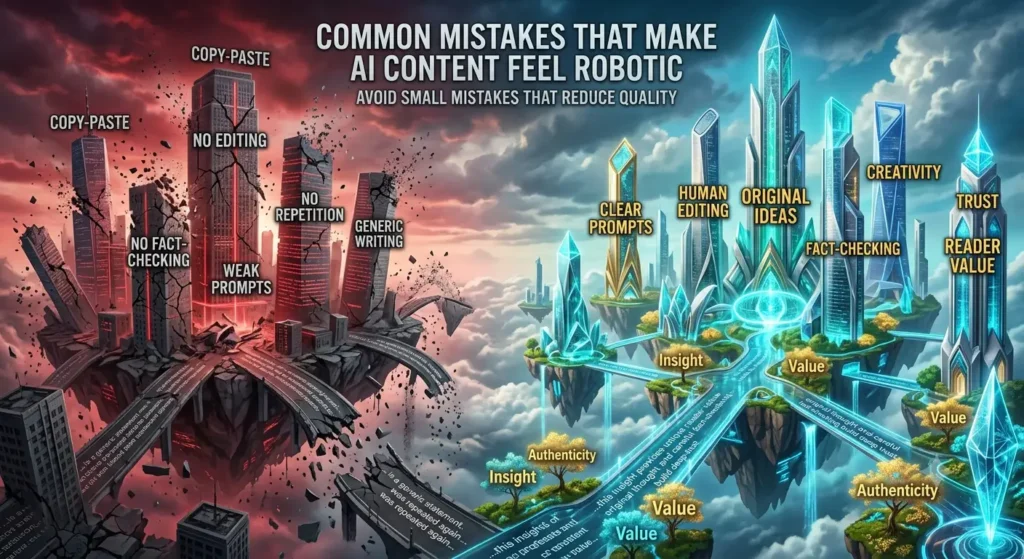
8. Common Mistakes That Make AI Content Feel Robotic
❓Why Does AI Content Sometimes Feel Boring?
Many people blame AI when their content sounds robotic.
In reality, AI is usually not the problem.
The biggest problem is how people use it.
Beginners often copy the first AI draft, make little or no changes, and publish it immediately. As a result, the content may be correct, but it doesn’t feel natural or enjoyable to read.
🚫 Mistake 1: Publishing the First Draft
The first AI response is only a starting point.
It may contain repeated ideas, awkward sentences, or unnecessary details. Publishing it without editing is one of the fastest ways to create low-quality content.
🌍 Real Example
A blogger asks AI to write a complete article and publishes it without reviewing anything. Readers notice repeated phrases and generic advice, making the article less engaging.
🚫 Mistake 2: Using Very Short Prompts
A short prompt usually produces a short and general answer.
AI works better when you clearly explain your goal, audience, and writing style.
🌍 Real Example
Instead of writing:
“Write about SEO.”
Try:
“Explain SEO for beginners using simple English, practical examples, and actionable tips.”
The second prompt gives AI much better direction.
🚫 Mistake 3: Forgetting the Reader
Some people focus so much on AI that they forget who the content is for.
Always think about your reader’s questions, problems, and experience level.
Content written for real people is always more valuable than content written only to fill a page.
🚫 Mistake 4: Adding No Original Value
If your article only repeats information that already exists online, readers have little reason to choose your content.
Add your own examples, lessons, observations, or practical advice whenever possible.
That’s what makes your content unique.
🚫 Mistake 5: Trusting AI Without Checking Facts
AI can sometimes make mistakes or provide outdated information.
Always review important facts before publishing, especially for topics like AI, technology, SEO, finance, or health.
A few minutes of fact-checking can protect your credibility.
💡 Actionable Tip
Before publishing any AI-assisted article, ask yourself:
• Did I improve the first draft?
• Did I add something original?
• Did I check the important facts?
• Would I enjoy reading this article myself?
If you answer “yes” to all four questions, you’re moving in the right direction.
📌 Key Takeaway
Most robotic AI content isn’t caused by AI itself—it’s caused by poor habits. By writing better prompts, editing carefully, adding your own ideas, and checking the facts, you can create content that feels natural and genuinely helps your readers.
FTPLAYEZ™ Insight: The easiest way to stand out isn’t by using a different AI tool. It’s by spending a little more time improving the content after AI finishes writing. Those extra improvements are often what readers remember most.
🔄 Smooth Transition
You’ve now learned what mistakes to avoid. The next step is seeing the difference for yourself. In the next section, we’ll compare AI-only content with human-improved AI content so you can clearly understand what separates average writing from high-quality content.
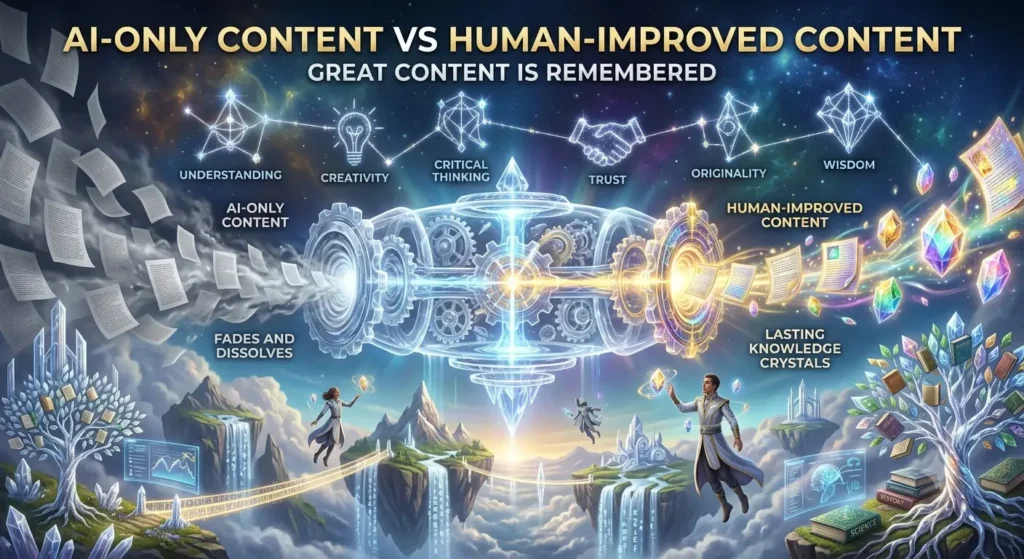
9. Human Content vs AI-Only Content
❓What’s the Difference Between AI Content and Human-Improved AI Content?
Many beginners believe that using AI automatically creates high-quality content.
That’s not true.
AI is excellent at creating a first draft, but a first draft is rarely the final product. The biggest difference comes from what happens after AI finishes writing.
Think of AI as someone who helps you build the foundation of a house. The foundation is important, but the painting, decoration, lighting, and finishing touches are what make it feel like a home.
Content works the same way.
📊 Comparison Table
| Feature | AI-Only Content | Human-Improved AI Content |
| Writing Style | Often generic | Natural and engaging |
| Examples | General | Personal and practical |
| Accuracy | May contain mistakes | Fact-checked |
| Personality | Limited | Unique voice |
| Reader Experience | Less engaging | Easier to enjoy and remember |
| Trust | Moderate | Stronger credibility |
🌍 Real Example
Imagine two bloggers writing about the same topic.
The first blogger copies AI’s answer and publishes it without making changes.
The second blogger uses AI to create the first draft, then rewrites difficult sentences, adds personal examples, checks important facts, and improves the flow.
Both articles explain the same topic.
However, readers are more likely to stay longer, trust the advice, and return to the second blog because it feels more helpful and authentic.
💡 Actionable Tip
Before publishing, compare your article with AI’s original draft.
Ask yourself:
Did I make the explanations simpler?
Did I add useful examples?
Did I improve the flow?
Did I make the content more helpful?
If the answer is yes, you’ve added real value instead of simply copying AI.
📌 Key Takeaway
The goal isn’t to hide the fact that you used AI. The goal is to create content that genuinely helps people. AI provides speed, but your editing, experience, and judgment create quality. That’s what transforms an ordinary article into one that readers trust and remember.
FTPLAYEZ™ Insight: I don’t measure the quality of an article by how quickly AI writes it. I measure it by how much better it becomes after thoughtful editing. That’s where the real value is created.
🔄 Smooth Transition
Now that you’ve seen the difference between AI-only content and human-improved content, it’s time to put everything together. In the next section, you’ll learn a simple step-by-step workflow that takes you from your first idea to a polished article that’s ready to publish.
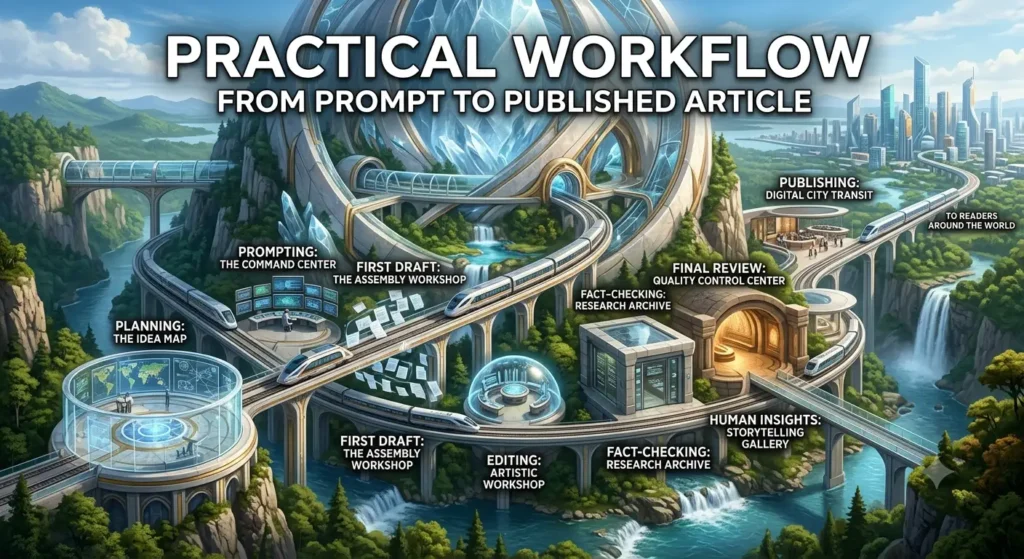
10. Practical Workflow: From Prompt to Published Article
❓How Do You Turn an AI Idea Into a High-Quality Article?
Learning prompting, editing, and fact-checking is important. But many beginners still ask one question:
“What should I do first?”
The easiest way to create great AI content is to follow the same workflow every time. Instead of guessing your next step, you simply move from one stage to the next.
Here’s a simple workflow you can use for almost any blog, article, or social media post.
📝 Step 1: Plan Your Content
Start with a clear goal.
Ask yourself:
• What topic am I writing about?
• Who is my audience?
• What problem will I solve?
A few minutes of planning helps you create more focused content and saves time later.
🤖 Step 2: Create the First Draft with AI
Now give AI a clear prompt.
Include your audience, writing style, and the goal of the content.
Remember, you’re asking AI to create a first draft, not a finished article.
✍️ Step 3: Edit and Improve
Read every paragraph carefully.
Simplify difficult sentences, remove repeated ideas, improve transitions, and add practical examples.
This is where your article begins to sound more human.
✅ Step 4: Check the Facts
Review important information before publishing.
If your article includes statistics, recent updates, or technical advice, compare it with trusted sources.
Accurate content builds trust with your readers.
🚀 Step 5: Publish and Keep Improving
Publishing isn’t the final step.
After your article goes live, watch how readers respond. If you notice better examples, new information, or areas that need improvement, update the article.
Great content grows over time instead of staying the same forever.
🌍 Real Example
When creating a FTPLAYEZ guide, I don’t try to finish everything in one sitting. I first plan the article, use AI to build the structure, improve every section one by one, check important facts, and then publish only after reviewing the entire guide. Following the same workflow each time makes the process faster and helps maintain consistent quality.
One habit that made the biggest difference for me was working on one improvement at a time. Instead of trying to perfect the entire article in one session, I focused on a single task—writing, editing, fact-checking, or improving readability. This made the process less overwhelming and helped me produce better content with fewer mistakes.
📊 AI-Only Workflow vs Human-Improved Workflow
| Step | AI-Only Workflow | Human-Improved Workflow |
| Planning | Often skipped | Clear goal and audience defined |
| Drafting | AI writes everything | AI creates the first draft |
| Editing | Little or no editing | Improve clarity, flow, and readability |
| Fact-Checking | Rarely verified | Important facts are checked |
| Final Result | Generic content | Helpful, natural, and trustworthy content |
💡 Actionable Tip
Create your own writing checklist and use it before every article.
A simple checklist can help you avoid common mistakes and make your content more consistent.
📌 Key Takeaway
A good workflow removes confusion. Instead of wondering what to do next, you follow the same five steps every time: Plan → Prompt → Edit → Fact-check → Publish. As you repeat this process, creating high-quality AI content becomes easier, faster, and more natural.
FTPLAYEZ™ Insight: Consistency is more valuable than speed. A simple workflow followed every time will usually produce better results than rushing to publish without a clear process.
🔄 Smooth Transition
You’ve now learned the complete workflow for creating high-quality AI content. But AI isn’t used only by bloggers. In the next section, you’ll see how students, freelancers, business owners, and content creators use the same principles in their daily work—and what you can learn from their approach.
11. Real-World Examples Across Different Professions
❓Who Can Benefit from Human-Like AI Content?
One of the biggest myths about AI content creation is that it’s only useful for bloggers or professional writers.
The truth is that almost anyone can benefit from these skills.
Whether you’re studying, running a business, creating videos, or working with clients, the same skills can help you create better content, save time, and communicate more clearly.
Let’s look at how different people use AI in their daily work.
🎓 Student
A student is preparing for a presentation on climate change.
Instead of asking AI to write the entire presentation, they use it to organize ideas, explain difficult topics, and create a simple outline. After that, they rewrite the content in their own words and add examples from their classroom lessons.
The result is easier to understand and reflects their own learning.
✍️ Blogger
A blogger wants to publish a detailed guide about personal finance.
They use AI to brainstorm headings and create the first draft. Then they edit each section, add real-life examples, include trusted references, and improve the explanations for beginners.
The final article feels natural because it combines AI’s speed with human experience.
💼 Freelancer
A freelance writer receives a new client project with a short deadline.
Instead of starting from a blank page, they use AI to generate ideas, draft the structure, and suggest different headlines. They then customize the content to match the client’s brand and audience.
This helps them work faster without lowering the quality of their work.
🛍️ Small Business Owner
A local bakery wants to promote a new product online.
The owner uses AI to create social media captions and email ideas. Before publishing, they add photos of the real products, mention customer favorites, and adjust the tone to match their business.
The posts feel personal because they reflect the business’s own identity.
🎥 Content Creator
A YouTuber is planning next month’s videos.
They use AI to generate topic ideas and organize the script. Then they add their own opinions, stories, and speaking style before recording.
The audience connects with the creator’s personality, not just the information.
💡 Actionable Tip
Don’t copy how someone else uses AI.
Instead, ask yourself:
“Which part of my work takes the most time?”
Start by using AI to improve that one task. As your confidence grows, you can expand your workflow step by step.
📌 Key Takeaway
The best AI users don’t depend on AI to do all the work. They use it to work smarter while adding their own knowledge, creativity, and experience. No matter what your profession is, the goal stays the same—create content that is useful, accurate, and genuinely helpful.
FTPLAYEZ™ Insight: AI doesn’t replace your skills—it helps you use them more efficiently. The more knowledge and experience you bring to the process, the more valuable your final content becomes.
🔄 Smooth Transition
You’ve now seen how people from different backgrounds use AI to create better content. To finish this guide, let’s answer some of the most common beginner questions that can help you avoid confusion and start using AI with confidence.
12. Frequently Asked Questions (FAQs)
❓Frequently Asked Questions About AI Content Creation
1. Can AI create high-quality content on its own?
AI can create a good first draft, but it cannot replace human thinking, creativity, and judgment. The best results come when you edit the content, add your own examples, and check the facts before publishing.
2. Is it okay to use AI for blog writing?
Yes. Many writers use AI to brainstorm ideas, create outlines, and write first drafts. However, you should always review and improve the content so it is accurate, helpful, and written for your audience.
3. Will Google rank AI-generated content?
Google focuses on helpful, high-quality content, not whether it was written with AI. If your article is original, accurate, and genuinely useful, it can perform well in search results. Publishing low-quality or unedited AI content is much more likely to cause problems than simply using AI as a writing assistant.
You can learn more about this in Google’s official guidance on creating helpful, reliable, people-first content.
4. How can I make AI content sound more natural?
Use clear prompts, edit every draft, remove repetitive phrases, add personal examples, and write in simple language. Reading your content aloud is also an easy way to find awkward sentences.
5. Should I fact-check AI-generated content?
Absolutely.
AI can sometimes provide outdated or incorrect information. Always verify important facts, statistics, and recent updates using trusted sources before publishing.
6. Which AI writing tool is best for beginners?
There isn’t one perfect tool for everyone. ChatGPT, Gemini, Claude, and other AI assistants all have strengths. The most important skill isn’t choosing the “best” tool—it’s learning how to use whichever tool you choose effectively.
7. Will AI replace content writers?
AI will change how people create content, but it won’t replace writers who can think critically, solve problems, and create valuable content. Writers who learn to work with AI will have a strong advantage.
8. What’s the biggest mistake beginners make?
The biggest mistake is publishing AI’s first draft without editing it. High-quality content is created by improving, fact-checking, and adding your own ideas—not by copying AI’s first response.
📌 Key Takeaway
AI is a powerful assistant, but your knowledge, creativity, and careful editing are what make content valuable. The more you practice these skills, the easier it becomes to create content that readers enjoy and trust.
🔄 Smooth Transition
You’ve learned the complete process—from writing better prompts to editing, fact-checking, and avoiding common mistakes. Let’s finish by bringing everything together with a few final thoughts and your next steps as an AI content creator.
13. Final Thoughts & Your Next Steps
🎉 You’re Ready to Create AI Content That Sounds Human
Creating high-quality AI content isn’t about finding a secret prompt or using the newest AI tool. It’s about following the right process.
In this guide, you’ve learned how to write better prompts, edit AI drafts, add your own personality, check important facts, and avoid the common mistakes that make content sound robotic. These skills work together to help you create content that is clear, useful, and trustworthy.
Remember, AI is a tool—not a replacement for your creativity. The ideas you share, the examples you add, and the time you spend improving each article are what make your content stand out.
Don’t worry if your first few articles aren’t perfect. Every piece of content you create is another opportunity to improve. The more you practice, the easier it becomes to write naturally and confidently with AI.
🚀 Your Next Step
Choose one topic you’re interested in and create a short article using the FTPLAYEZ™ H.U.M.A.N. Framework you learned in this guide. Focus on helping your readers, not just finishing the article. Small improvements made consistently lead to big results over time.
If you’re new to AI content creation, I also recommend reading our AI Content Creation: The Complete Beginner’s Guide (2026). It explains the fundamentals and works perfectly alongside this guide.
Thank you for learning with FTPLAYEZ™. I hope this guide helps you create content that not only sounds human but also makes a real difference for your readers.