Struggling to get powerful results from ChatGPT?
This guide teaches proven prompt engineering frameworks used by professionals — step-by-step.
📌 Save this guide — use these frameworks anytime you write prompts.
📍 Table of Contents
1. Introduction: Why Frameworks Matter More Than You Think
2. What Is Prompt Engineering? (Simple Definition)
3. Why Frameworks Improve AI Output
5. The Role + Context + Constraint Model
6. Zero-Shot vs Few-Shot Prompting (Explained Simply)
7. Chain-of-Thought Prompting (Step-by-Step Thinking)
8. When to Use Which Framework (Real Use Cases)
9. Framework Stacking (Advanced Strategy)
10. Common Framework Misuse (And Why Results Fail)
11. Professional Prompt Workflow (How Experts Actually Work)
12. The Strategic Mindset Shift
13. The Real Competitive Advantage
14. Frequently Asked Questions
15. Final Conclusion: Frameworks Create Thinking Power
🏗️ Introduction: Why Frameworks Matter More Than You Think
Most people use ChatGPT like this:
They open it.
They type a quick question.
They hope for a good answer.
Sometimes it works.
Sometimes it doesn’t.
And when it doesn’t, they think:
“AI is inconsistent.”
But the real issue is not intelligence.
It is structure.
Professionals do not rely on luck when using AI.
They use frameworks.
A framework is simply a structured way of thinking.
Think about building a house.
You would not say:
“Build me something.”
You would create a plan.
You would define:
• What kind of house
• How many rooms
• What materials
• What budget
• What style
That plan is your framework.
Prompt engineering works the same way.
When you follow a structure, AI becomes more predictable.
More accurate.
More useful.
In this guide, you will learn:
• What prompt engineering really means
• Why frameworks improve AI results
• The RACE framework
• Role + Context + Constraint model
• Zero-shot vs Few-shot prompting
• Chain-of-thought prompting
• When to use each framework
• How professionals combine frameworks
• And how to think structurally, not randomly
And don’t worry.
We will explain everything in very simple language.
No technical background needed.
Let’s begin.
⚙️ What Is Prompt Engineering? (Simple Definition)
Prompt engineering means:
Designing your instructions in a smart and structured way so AI gives better results.
That’s it.
It is not coding.
It is not hacking.
It is not something only developers do.
It is simply:
Learning how to give clear instructions.
If you tell AI:
“Write about health.”
That is a weak instruction.
If you tell AI:
“Act as a health coach. Write a 600-word beginner guide about improving sleep for office workers. Use simple language and include 3 actionable tips.”
That is prompt engineering.
You are designing the instruction carefully.
The output changes because your input changed.
This is the core idea.
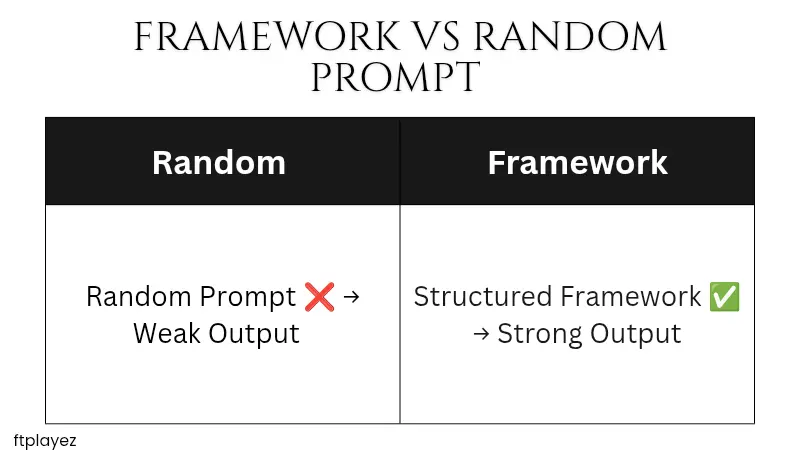
Better structure → Better results.
👉 New to prompt writing? Start here →
💡 Pro Tip: Prompt engineering is not about writing more — it’s about structuring better.
📈 Why Frameworks Improve AI Output
You might ask:
“Why can’t I just write naturally?”
You can.
But frameworks give you advantages.
1️⃣ Frameworks Reduce Confusion
AI fills in gaps when you leave details out.
Frameworks help you include important details automatically.
2️⃣ Frameworks Increase Consistency
Without structure: Some answers are good. Some are average.
With structure: Results become predictable.
That saves time.
3️⃣ Frameworks Make Prompting Repeatable
If you discover a prompt that works well, you can reuse the framework.
You don’t need to start from zero every time.
Professionals love repeatable systems.
4️⃣ Frameworks Help You Think Clearly
The biggest benefit is not AI performance.
It is your thinking.
When you use a framework, you ask yourself:
• What role should AI take?
• What context matters?
• What output format do I need?
• What constraints improve clarity?
You start thinking like a strategist.
That is powerful.
⚠️ Common Mistake: Using AI without a framework leads to inconsistent and random results.
⭐
Frameworks improve output because:
• They remove confusion
• They add structure
• They guide AI thinking
• They reduce random results
🏎️ The RACE Framework
One of the simplest and most effective frameworks is RACE.
RACE stands for:
Role
Action
Context
Expectation
Let’s break this down.
R – Role
Tell AI who it should act as.
Examples:
“Act as a marketing expert.”
“Act as a high school math teacher.”
“Act as a startup business advisor.”
Why this works:
When you define a role, AI adjusts tone, depth, and vocabulary.
It stops guessing.
A – Action
Tell AI what to do.
Examples:
• Explain
• Create
• Analyze
• Compare
• Summarize
• Design
Be specific.
“Explain the benefits of meditation.”
Clear action = clear output.
C – Context
Context explains background.
Who is the audience?
What is the situation?
What problem are we solving?
Example:
“For beginners who have never meditated before.”
Now AI knows how simple the explanation should be.
E – Expectation
Expectation defines output quality and format.
Examples:
• In 300 words
• In bullet points
• In table format
• With 3 real-life examples
• In a friendly tone
This controls the final result.
RACE Framework Example
Let’s compare.
Weak Prompt:
“Write about time management.”
Very vague.
RACE Prompt:
“Act as a productivity coach (Role).
Explain time management techniques (Action)
for college students who struggle with procrastination (Context).
Give 5 practical tips in bullet points using simple language (Expectation).”
See the difference?
This is not complicated.
It is structured thinking.
When to Use RACE
Use RACE when:
• You want educational content
• You are writing blogs
• You are creating study notes
• You need structured explanations
• You want predictable output
It is perfect for most general tasks.
🚀 Quick Win: Even a simple framework like RACE can dramatically improve output quality.
⭐
RACE Framework:
• Role → Define who AI should act as
• Action → What task to perform
• Context → Background information
• Expectation → Output format
👤 The Role + Context + Constraint Model
This is one of the most powerful and practical models you can use daily.
It is simple.
It is flexible.
And it works in almost every situation.
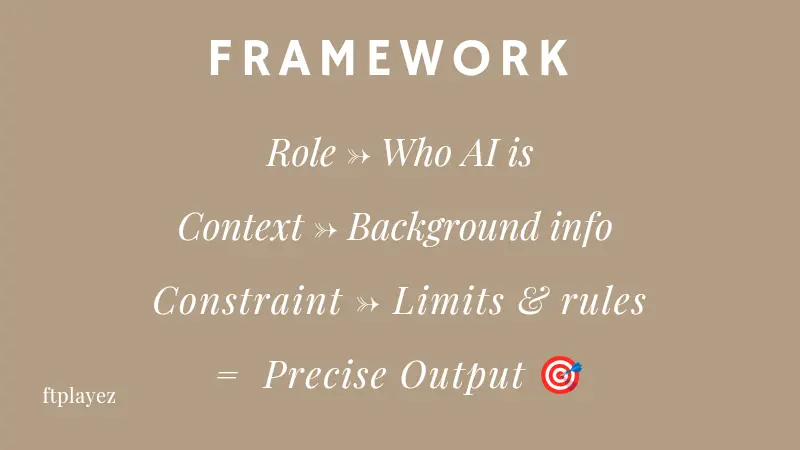
The structure looks like this:
Role
Context
Task
Format
Constraint
Let’s understand each one clearly.
1️⃣ Role
We already saw this in RACE.
Role defines identity.
When you assign a role, you change:
• Tone
• Depth
• Vocabulary
• Perspective
Example:
“Act as a lawyer.”
versus
“Act as a friendly tutor.”
Same topic. Different output.
Role removes guessing.
2️⃣ Context
Context answers:
Who is this for?
What situation are we in?
Why is this needed?
Without context, answers become generic.
Example without context:
“Explain budgeting.”
Example with context:
“Explain budgeting for a young couple who just got married and have limited income.”
Now the advice becomes specific.
Context makes content relevant.
3️⃣ Task
Task is the main action.
Explain
Create
Compare
Summarize
Rewrite
Analyze
Be direct.
Weak: “Tell me about leadership.”
Better: “Explain 5 leadership qualities.”
Clear task = structured output.
4️⃣ Format
Format controls presentation.
Do you want:
• Bullet points?
• A table?
• A step-by-step guide?
• A short paragraph?
• A numbered list?
If you do not define format, AI chooses randomly.
And sometimes it chooses wrong.
5️⃣ Constraint
Constraint means limitation.
Limitations improve quality.
Examples:
• In 200 words
• Under $1,000 budget
• For beginners only
• Avoid technical terms
• Include 2 real examples
Constraints narrow the answer.
Narrow answers are usually stronger.
Full Example Using This Model
Let’s build one together.
“Act as a digital marketing mentor (Role).
Create a simple Instagram growth strategy (Task)
for a small bakery in a local town (Context).
Present it in a 7-step checklist (Format).
Keep it beginner-friendly and under 400 words (Constraint).”
This prompt rarely produces weak output.
Why?
Because there is no confusion.
When to Use This Model
Use it when:
• You want full control
• You are creating content
• You are building business plans
• You want repeatable high-quality results
It is more detailed than RACE.
If RACE is simple structure, this model is structured precision.
👉 Want ready-to-use frameworks and prompts?
Check out my complete prompt pack — designed to save hours of work.
🎯 Zero-Shot vs Few-Shot Prompting (Explained Simply)
Now let’s understand two important ideas in prompt engineering.
Do not worry. We will keep it very simple.
Zero-Shot Prompting
Zero-shot means:
You give instruction without giving any example.
Example:
“Write a motivational speech for students before exams.”
You did not show an example.
AI uses its training patterns to generate one.
Zero-shot is fast and simple.
It works well for general tasks.
Few-Shot Prompting
Few-shot means:
You give one or more examples before asking for output.
Example:
“Here is an example of a motivational paragraph:
‘Success is not about being perfect…’
Now write a similar motivational speech for students preparing for exams.”
Now AI follows the example’s style.
Few-shot improves:
• Tone consistency
• Style matching
• Format precision
It is powerful when you want:
• Brand voice consistency
• Specific writing styles
• Pattern imitation
When to Use Zero-Shot
Use zero-shot when:
• Task is simple
• You do not care about exact style
• You want quick results
When to Use Few-Shot
Use few-shot when:
• You want consistent tone
• You have a writing style to copy
• You want structured formatting
• You are building brand voice
Few-shot reduces randomness.
⭐
Zero-Shot:
• No examples
• Direct instruction
Few-Shot:
• Includes examples
• Better for complex tasks
🔗 Chain-of-Thought Prompting (Step-by-Step Thinking)
This is another powerful framework.
Chain-of-thought simply means:
Ask AI to explain step-by-step.
Example:
“Explain step-by-step how to start an online business with zero investment.”
When you say “step-by-step,” AI breaks reasoning into parts.
This improves:
• Logic
• Clarity
• Depth
Why It Works
AI predicts patterns.
When you request step-by-step explanation, it switches to reasoning mode.
It slows down and becomes structured.
Example Comparison
Weak prompt:
“How can I save money?”
Better prompt:
“Explain step-by-step how a college student can save money each month, including budgeting and spending habits.”
Second one produces clearer structure.
When to Use Chain-of-Thought
Use it when:
• Problem-solving
• Planning
• Math reasoning
• Business strategies
• Study explanations
It is especially useful for complex topics.
Framework Comparison (Simple Overview)
Let’s compare what we learned so far.
RACE
Good for general structured content.
Role + Context + Constraint
Best for precision and control.
Zero-Shot
Fast and simple.
Few-Shot
Best for style matching.
Chain-of-Thought
Best for deep reasoning.
Each has a purpose.
No single framework is “best.”
The best one depends on your goal.
💡 Pro Tip: If a task requires thinking, always guide AI step-by-step.
⭐
Chain-of-Thought works when:
• Task is complex
• Logical reasoning is needed
• Step-by-step thinking improves accuracy
📊 When to Use Which Framework (Real Use Cases)
Knowing frameworks is good.
Knowing when to use them is powerful.
Let’s break it down practically.
🧩 Scenario 1: Writing a Blog Post
Goal: Structured, SEO-friendly, professional content.
Best Framework: Role + Context + Constraint (or RACE)
Why?
Because blog writing needs:
• Clear audience targeting
• Structured sections
• Tone control
• Formatting rules
Example:
“Act as an SEO content strategist.
Write a 1,200-word blog post about email marketing for beginners.
Target small business owners.
Use H2 and H3 headings.
Include practical examples and a short checklist at the end.”
This gives you precision.
📊 Scenario 2: Solving a Business Problem
Goal: Deep reasoning and structured thinking.
Best Framework: Chain-of-Thought
Example:
“Explain step-by-step how a struggling local gym can increase monthly memberships without increasing ad spend.”
Here you need reasoning.
Chain-of-thought reduces surface-level answers.
🎨 Scenario 3: Matching a Brand Voice
Goal: Consistent tone.
Best Framework: Few-Shot Prompting
Example:
“Here are two examples of our brand voice: [Insert sample paragraph 1] [Insert sample paragraph 2]
Now write a product description for our new fitness tracker in the same tone.”
Few-shot ensures style alignment.
⚡ Scenario 4: Quick General Answer
Goal: Fast information.
Best Framework: Zero-Shot
Example:
“Explain what blockchain is in simple terms.”
Simple task. No need for complex structure.
🎓 Scenario 5: Educational Content Creation
Goal: Structured explanation for learning.
Best Framework: Role + Chain-of-Thought combined
Example:
“Act as a university professor.
Explain step-by-step how inflation affects purchasing power, using simple real-life examples.”
Now you control tone AND reasoning.
That’s advanced prompting.
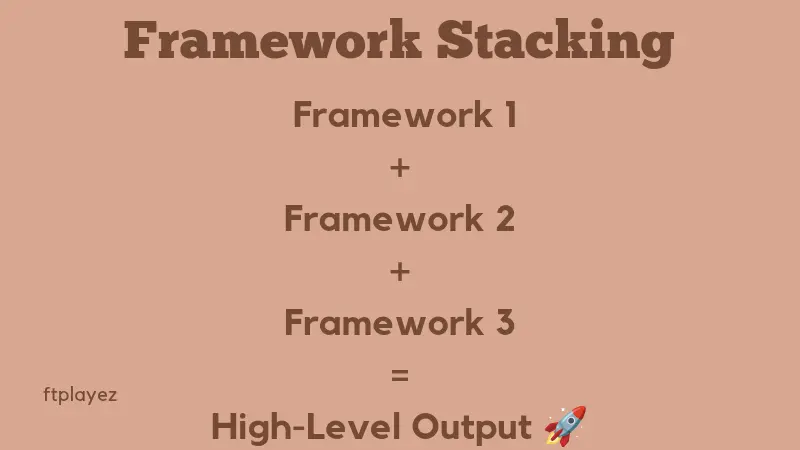
🔳 Framework Stacking (Advanced Strategy)
This is where professionals operate.
You do not choose only one framework.
You combine them.
Example:
“Act as a financial advisor (Role).
Step-by-step explain how a 25-year-old can start investing (Chain-of-Thought).
Assume they have $500 per month to invest (Context).
Present it in a simple numbered guide (Format).
Avoid technical jargon (Constraint).”
This stacks:
Role
Chain-of-Thought
Context
Constraint
Format
Stacking frameworks = higher quality output.
👉 Want advanced templates and real systems? Explore →
⭐
Stacking frameworks helps:
• Combine strengths
• Handle complex tasks
• Produce high-level output
❌ Common Framework Misuse (And Why Results Fail)
Let’s fix common mistakes.
❌ Mistake 1: Too Many Conflicting Constraints
Example:
“Write a detailed 2,000-word guide in 100 words.”
Contradiction creates weak output.
Be realistic.
❌ Mistake 2: Overcomplicating Simple Tasks
If you just want a definition, do not build a 7-layer framework.
Use zero-shot.
Efficiency matters.
❌ Mistake 3: Forgetting the Audience
You may define role and format, but forget who it is for.
Audience context changes everything.
❌ Mistake 4: Not Iterating
Professional prompting is iterative.
You refine. You improve. You adjust.
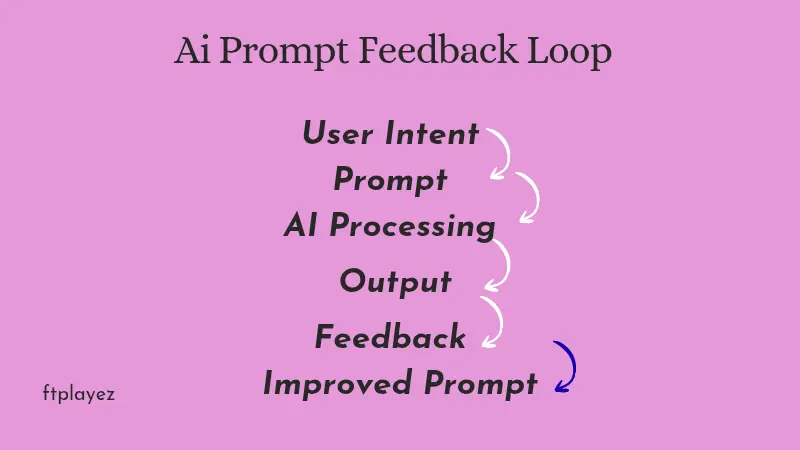
Prompting is a feedback loop.
👉 Making mistakes with prompts? Fix them here →
⭐
Common mistakes:
• Using wrong framework
• Skipping context
• Overcomplicating prompts
• Not refining outputs
❇️ Professional Prompt Workflow (How Experts Actually Work)
Here’s how serious creators use AI.
Step 1: Define Objective
What do I want? Information? Content? Strategy? Creative output?
Step 2: Choose Framework
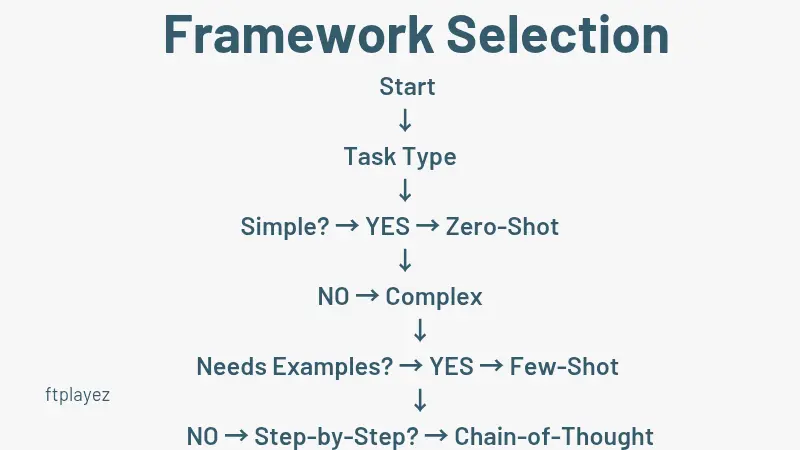
Simple → Zero-shot
Structured → RACE
Precise → Role + Context + Constraint
Deep reasoning → Chain-of-Thought
Style matching → Few-shot
Step 3: Add Constraints
Length
Tone
Audience
Format
Depth
Constraints improve clarity.
Step 4: Review Output
Is it:
• Too generic?
• Too shallow?
• Too complex?
If yes → refine prompt.
Step 5: Iterate
Add:
• More context
• Clearer audience
• Better constraints
• Example inputs
Iteration is where mastery happens.
👉 Want to apply prompts in SEO and content? Check this →
🧠 The Strategic Mindset Shift
Prompt engineering is not about tricking AI.
It is about structured thinking.
When you design a good prompt, you clarify your own thinking.
You define:
• Goal
• Audience
• Format
• Constraints
• Outcome
That is strategic communication.
And that skill applies beyond AI.
It improves:
• Writing
• Leadership
• Planning
• Teaching
• Problem-solving
Prompt engineering is modern structured thinking.
⭐
**Frameworks are not shortcuts — they are thinking tools.**
🏆 The Real Competitive Advantage
Many people use AI.
Few people use it strategically.
The difference is not the tool.
The difference is:
• Clarity
• Structure
• Intentionality
Frameworks give you repeatability.
Repeatability gives you consistency.
Consistency builds authority.
📌 Save This Page for Later
This is not just a guide — it’s your framework library.
Come back whenever you need:
• Better prompts
• Clear thinking structure
• High-quality AI outputs
👉 Bookmark this page and use it as your daily reference.
❓ Frequently Asked Questions
❓ What is a prompt engineering framework?
A prompt engineering framework is a structured method used to write clear and effective prompts.It helps improve AI output by adding clarity, context, and direction.
❓ Why are frameworks important in ChatGPT prompting?
Frameworks reduce randomness and improve consistency.They guide AI step-by-step, leading to better and more accurate results.
❓ What is the best prompt framework for beginners?
The Role + Context + Constraint model is one of the easiest and most effective frameworks for beginners.
❓ When should I use Chain-of-Thought prompting?
Use it when tasks require reasoning, logic, or step-by-step thinking.It helps improve accuracy for complex problems.
❓ What is the difference between zero-shot and few-shot prompting?
Zero-shot uses no examples, while few-shot includes examples.Few-shot works better for complex or specific tasks.
❓ Can I combine multiple frameworks together?
Yes. This is called framework stacking.It helps solve complex tasks and generate higher-quality outputs.
🚀 Quick Win: Frameworks don’t limit creativity — they enhance precision.
🏁 Final Conclusion: Frameworks Create Thinking Power
Prompt engineering is not a collection of tricks.
It is a system of structured communication.
RACE helps you organize instructions.
Role + Context + Constraint gives precision.
Zero-shot gives speed.
Few-shot gives stylistic control.
Chain-of-thought gives reasoning depth.
When you understand when and how to use each framework, AI stops feeling random.
It starts feeling powerful.
But here is the deeper truth:
The more structured your prompts become, the more structured your thinking becomes.
And that is the real upgrade.
Not better AI answers.
Better thinking.
That is prompt engineering.
And that is your advantage. 🚀
Now the next step is simple:
Don’t just read these frameworks.
Start applying them.
Take one framework.
Use it today.
Test it on a real task.
Then improve it.
Because mastery doesn’t come from knowing frameworks…
It comes from using them.
👉 The people who win with AI are not the ones who ask more questions…
They are the ones who ask better, structured questions.